
DHI vs FUE Hair Transplant: Which Is Right for Indian Men?
Choosing between DHI vs FUE hair transplant in India? Explore how follicle mechanics, Norwood staging, and graft survival rates impact Indian men seeking hair restoration.
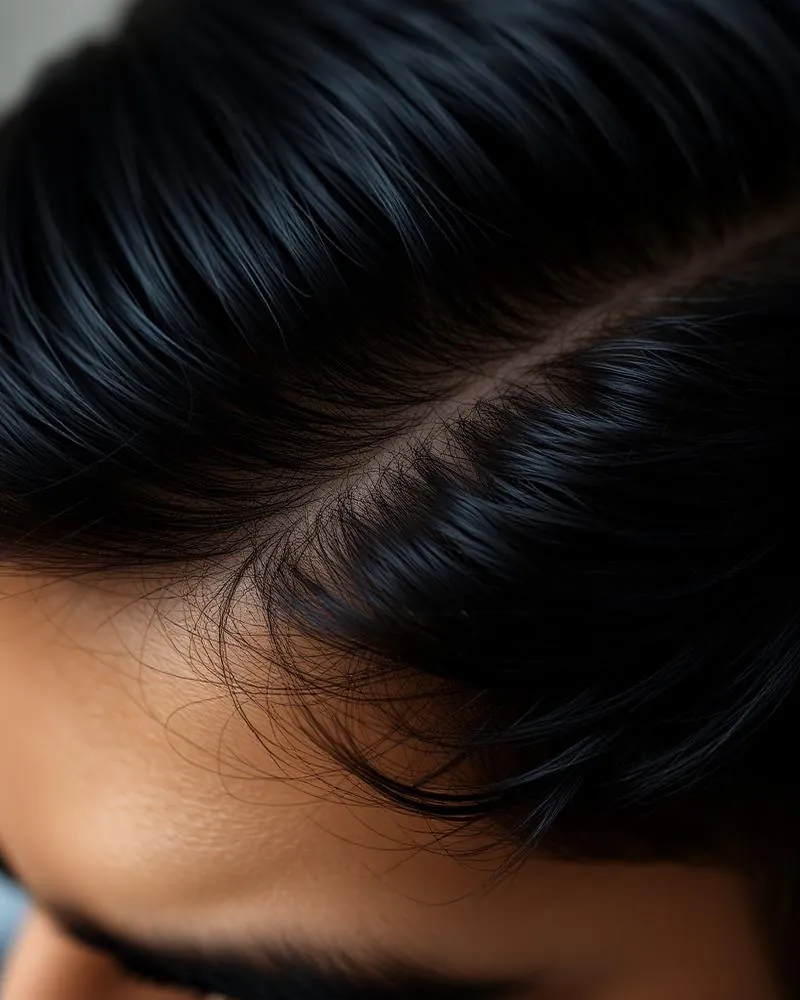
When comparing DHI vs FUE hair transplant India techniques, the clinical consensus is that neither method is universally superior; rather, the right choice depends on your specific Norwood scale stage, hair density, and budget. Follicular Unit Extraction (FUE) remains the gold standard for high-volume graft requirements (typically 3,000+ grafts) across broader areas of baldness, while Direct Hair Implantation (DHI) offers superior precision and depth control for hairline design, crown restoration, and densification without shaving the recipient zone.
Key Takeaways (TL;DR)
- Mechanism: FUE involves punching grafts and making premade channel incisions before manual placement. DHI uses a specialized Choi implanter pen to incise and implant simultaneously.
- Indian Hair Profile: Indian men often possess thicker, wavy hair shafts with mild sub-dermal root curvature; both micro-FUE and DHI manage this well when performed by a skilled surgeon.
- Graft Volumes: FUE is ideal for Norwood Stages 4 to 7 (extensive baldness). DHI is best suited for Norwood Stages 2 to 4 (targeted hairline or temple restoration).
- Recovery: DHI generally features slightly faster recipient-site healing and minimal crusting, while donor-site healing is identical in both procedures.
- Cost Considerations: DHI is typically 25% to 40% more expensive across India due to specialized single-use implanter equipment and extended surgical duration.
Understanding the Core Difference: How FUE and DHI Actually Work
To make an informed decision about surgical hair restoration, it helps to understand what happens to individual follicular units from extraction to placement.
FUE Workflow:  [Extraction via Micro-Motor] -> [Graft Sorting & Hydration] -> [Recipient Slit Incisions] -> [Manual Forceps Placement]
DHI Workflow:  [Extraction via Micro-Motor] -> [Graft Loaded into Choi Pen] -> [Simultaneous Incision & Implantation]
Follicular Unit Extraction (FUE)
In standard FUE, the surgical team uses a motorized micro-punch (0.7 mm to 0.9 mm in diameter) to isolate follicular units from the permanent donor zone (the back and sides of the scalp). Once extracted, the grafts are stored in a chilled holding solution—such as HypoThermosol or saline—while the surgeon manually creates recipient sites (slits or microscopic channels) across the bald areas using micro-sapphire blades or surgical needles. Technicians then gently place the harvested follicles into these channels using micro-forceps.
Direct Hair Implantation (DHI)
DHI is technically an advanced modification of the extraction-to-placement pipeline. The extraction phase uses identical micro-punch mechanics as advanced FUE. However, the recipient phase removes the channel-making step. Each harvested graft is loaded into the hollow needle of a spring-loaded "Choi Implanter Pen." The surgeon inserts the needle directly into the dermis at a predetermined angle, depth, and direction, and presses the plunger to deploy the follicle directly into the scalp in a single movement.
At our centre in Bhopal, Madhya Pradesh, Dr Pankaj Peswani evaluates each patient's follicle health under dermoscopy to determine which implantation approach delivers the highest yield.
Hair Biology in Indian Men: Root Curvature and Scalp Characteristics
Indian hair profiles present unique surgical dynamics that dictate how follicular units must be handled:
- Sub-Dermal Root Curvature: Unlike East Asian hair (which is dead-straight) or Afro-textured hair (which features tight, helical coils), hair in Indian men commonly exhibits a straight external shaft with a slight internal root curve beneath the dermal surface. If extraction punches lack calibrated alignment, the risk of graft transection (cutting the follicle bulb) increases.
- High Melanin Content: Dark hair contrasting against lighter scalp tones means proper angulation is critical. Any unnatural placement of perpendicular hairs stands out sharply.
- Sebum and Sweat Production: Tropical climatic conditions across central India, including Bhopal and the wider Malwa region, mean higher active sweat gland activity post-surgery. Techniques that reduce recipient wound surface area can aid immediate post-operative hygiene.
Because both standard FUE and DHI utilize micro-motor extraction, the surgeon's tactile feedback matters far more than the marketing name of the technique. High graft survival depends on minimizing out-of-body time, controlling tissue hydration, and preventing mechanical trauma during insertion.
Comparison: DHI vs FUE Hair Transplant in India
The following clinical parameters compare traditional Sapphire FUE and DHI for male pattern hair loss (Androgenetic Alopecia):
| Parameter | Sapphire FUE | DHI (Choi Implanter) | Clinical Relevance for Indian Men |
|---|---|---|---|
| Channel Creation | Pre-cut micro-incisions before placement | Simultaneous incision and graft deposit | DHI reduces recipient trauma; FUE allows faster channel mapping for large zones. |
| Maximum Grafts per Session | 3,500 – 4,500+ grafts | 2,000 – 3,000 grafts | FUE is better suited for high-grade Norwood scale baldness. |
| Graft Out-of-Body Time | Moderate (1.5 to 3 hours in preservation bath) | Low (can be implanted in continuous batches) | Reduced ischemia time in DHI can modestly improve fragile graft survival. |
| Need to Shave Recipient Area | Usually required for uniform spacing | Optional (Unshaven / Partial-shaven possible) | DHI allows executive/discrete transplants without full head shaving. |
| Angulation & Depth Control | Excellent (controlled by blade slit angle) | Exceptional (controlled on every individual stroke) | DHI excels at high-density restoration along the frontal hairline. |
| Session Duration | 5 to 7 hours | 6 to 9 hours | DHI demands higher surgeon physical endurance per graft. |
| Typical Cost in India | ₹20 – ₹45 per graft | ₹35 – ₹70+ per graft | DHI carries higher procedural overhead for disposable pen tips. |
Candidacy Factors: Which Technique Matches Your Hair Loss?
Choosing the correct protocol requires matching your stage of androgenetic alopecia with realistic donor-supply economics.
                    [Your Hair Loss Assessment]
                                 │
         ┌───────────────────────┴───────────────────────┐
         ▼                                               ▼
[Norwood Stages 1 to 3]                         [Norwood Stages 4 to 7]
• Receding hairline                             • Significant crown + frontal loss
• Diffuse thinning between native hairs         • High graft requirement (3,000+)
• Prefer not to shave recipient area             • Broad surface area coverage needed
         │                                               │
         ▼                                               ▼
   BEST FIT: DHI                                   BEST FIT: FUE
When DHI is the Preferred Option
- Frontal Hairline Lowering & Temple Reconstruction: DHI provides sub-millimeter control over the acute 10-to-15-degree exit angle required at the immediate transitional hairline.
- Diffused Thinning (Between Existing Native Hairs): If you still have significant native hair on top that is thinning, pre-made FUE incisions can inadvertently transect adjacent native roots. A Choi implanter allows the surgeon to slip between existing hairs without damaging viable neighbors.
- Unshaven Procedures: Many working professionals visiting clinics near me in Bhopal request discrete procedures where their colleagues cannot easily detect surgical intervention.
When FUE is the Preferred Option
- Advanced Baldness (Norwood Stages 4, 5, 6, and 7): When restoring an entire scalp from hairline to crown, graft efficiency and procedural time are paramount. Standard or Sapphire FUE allows a coordinated surgical team to harvest and implant 3,500 to 4,500 grafts safely within a single clinical day.
- Budget Optimization: Because DHI requires multiple single-use Choi needles and dedicated physician-only implantation time, it increases overall procedure costs. FUE offers high clinical yield and natural coverage at a more accessible investment level for Indian patients.
To view real clinical transformations across both approaches, explore our hair treatments performed under strict aseptic surgical protocols.
Recovery, Graft Survival, and Long-Term Results
Both surgical modalities share identical donor-area biology: tiny puncture sites that close via secondary intention within 48 to 72 hours, leaving virtually imperceptible micro-scars.
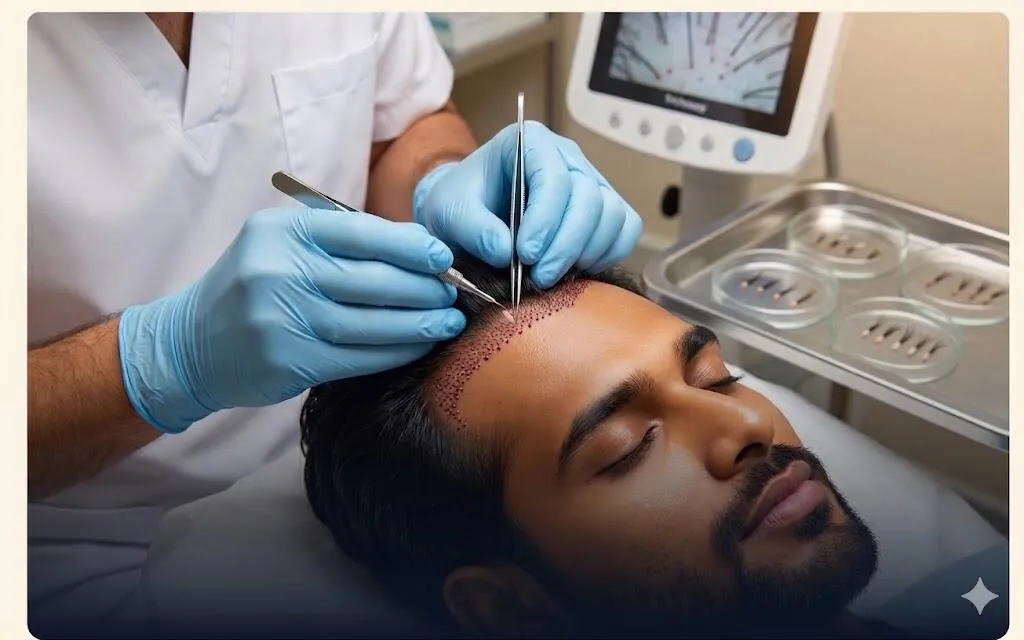
The First 14 Days
- FUE Healing: Small micro-crusts form over each pre-made channel incision. These scabs fall off naturally between days 8 and 12 during warm-water saline washes.
- DHI Healing: Because the Choi needle creates an incision perfectly sized to the follicle, epidermal bleeding and subsequent scab formation are often reduced. Redness (erythema) typically clears slightly faster.
The Growth Timeline (Identical for Both Techniques)
- Weeks 2 to 8: The transplanted hair shafts will shed—a completely normal physiological phenomenon called telogen effluvium (shock loss). The underlying follicular stem cell bulb remains secure in the dermal vascular network.
- Months 3 to 4: Fine, new anagen-phase hairs emerge from the scalp.
- Months 6 to 9: Density, caliber, and natural pigmentation dramatically improve.
- Month 12: Full cosmetic density is established.
In our clinical experience in Madhya Pradesh, long-term graft survival (exceeding 90–95%) depends far more on the surgeon's gentle handling of the follicle sheath, depth control to avoid "pitting" or "tenting," and correct post-op care than on the brand of tool used.
Complementary Therapies for Longevity
A hair transplant restores lost hair, but it does not stop progressive genetic sensitivity in non-transplanted native follicles. Indian men experiencing active thinning often benefit from pairing their transplant with comprehensive medical therapy supervised by Dr Khushboo Peswani and our clinical dermatology team.
Adjunctive treatments often include:
- Oral 5-Alpha Reductase Inhibitors (Finasteride/Dutasteride): Stabilizes DHT-mediated miniaturization of your existing crown and mid-scalp hair.
- Topical or Oral Minoxidil: Improves microvascular perfusion around both native and newly grafted roots.
- Autologous Platelet-Rich Plasma (PRP) / GFC Therapy: Concentrated growth factors injected into the scalp accelerate tissue revascularization and reduce the post-operative shock-shedding period.
When to See a Hair Restoration Doctor in Bhopal
Not every stage of hair thinning requires immediate surgery. Consider scheduling an in-person clinical evaluation if:
Clinical Checkpoint
- You notice progressive recession at the fronto-temporal angles (M-shaped hairline) that does not respond to 6 months of topical medical therapy.
- Your donor area at the occipital scalp remains dense and healthy, but mid-scalp thinning makes your scalp clearly visible under indoor lighting.
- You have stable hair loss and are over 23 to 25 years old (operating on unstable, rapidly receding patterns in very young men can lead to unnatural "island" patches later in life).
If you reside in Bhopal, Sehore, Vidisha, or nearby districts, visit our specialized centre at Lalghati for a comprehensive trichoscopic scalp scan.
Ready to map your hairline and calculate your exact graft requirement? Book consultation with our surgical team today.
Medical Disclaimer: The information presented in this article is for educational purposes and does not constitute formal medical advice. Suitability for surgical hair restoration (FUE or DHI) requires an individualized evaluation of donor density, systemic health, and scalp condition by a qualified cosmetic surgeon.
Frequently asked questions
Which is better for Indian hair: DHI or FUE?
Neither technique is universally better. DHI is ideal if you need high-density hairline framing, temple reconstruction, or wish to avoid shaving existing hair. FUE is superior and more economical if you have extensive baldness requiring 3,000 to 4,500+ grafts in one sitting.
Is DHI more painful than standard FUE?
No. Both procedures are carried out under local tumescent anesthesia. You will feel minor pricks during the initial numbing phase, but the extraction and implantation steps are completely pain-free regardless of whether Choi implanters or Sapphire blades are utilized.
Why does DHI cost more than FUE across clinics in India?
DHI requires specialized single-use Choi implanter pens and titanium needle cartridges for every patient. Furthermore, the procedure is physician-intensive, as the surgeon directly implants every follicle individually, which increases the surgical time and overhead.
Can I get a DHI hair transplant without shaving my head?
Yes. One of DHI's major advantages is that only a small strip in the rear donor zone needs trimming, which can easily be hidden under longer hair. The recipient balding area does not require shaving, making it popular for working professionals.
How long do results from FUE and DHI hair transplants last?
Transplanted hair follicles from the permanent donor zone (occipital area) are genetically resistant to dihydrotestosterone (DHT). Whether placed via FUE or DHI, these transplanted follicles survive and grow naturally for a lifetime with proper maintenance.
Talk to our doctors in Bhopal
Book a private consultation at HT Cosmetic & Trauma Centre, Lalghati, Bhopal — or chat with us on WhatsApp.