
DHI vs FUE Hair Transplant: Which Is Right for Indian Men?
Deciding between DHI and FUE hair transplant in India? Learn how each method works, compare graft survival and costs, and find the right option for your hair type.
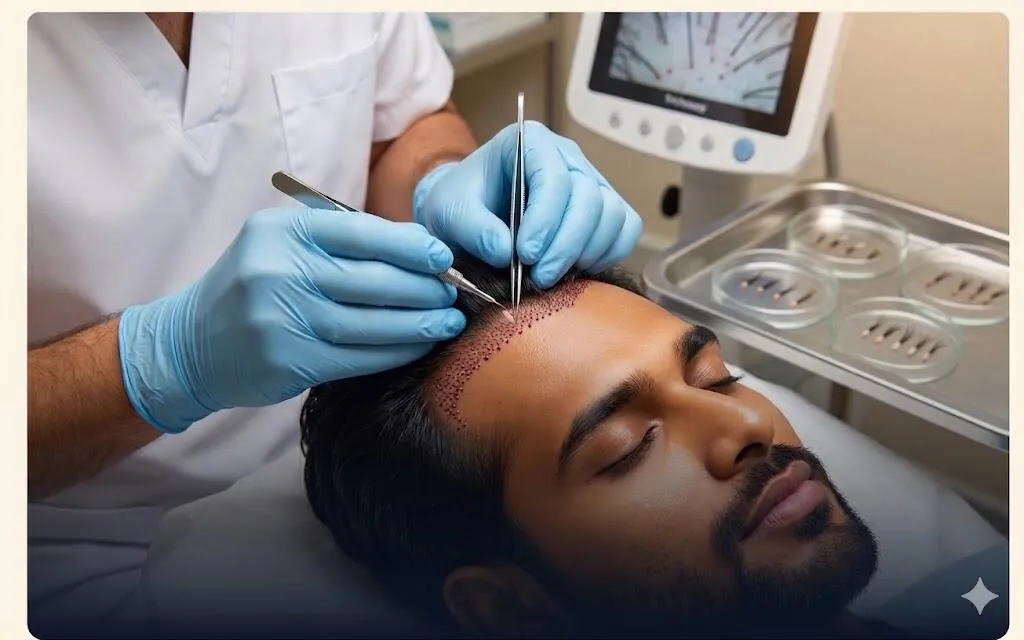
When comparing a DHI vs FUE hair transplant India, the fundamental difference lies in how donor follicles are implanted into the balding scalp. Follicular Unit Extraction (FUE) extracts individual follicular units and places them into pre-made channel incisions using micro-forceps, making it the most cost-effective solution for extensive coverage. Direct Hair Implantation (DHI) uses a specialized implanter pen (such as the Choi Implanter) to create the channel and deposit the graft simultaneously, offering unmatched angle precision and higher density for hairline restoration. For Indian men, the ideal choice depends on donor density, the degree of male pattern baldness, and aesthetic expectations.
TL;DR: Quick Summary
- FUE (Follicular Unit Extraction): Excellent for large bald patches (Norwood Grades 3 to 7), highly cost-effective, leaves microscopic dot scars, requires slit creation before graft insertion.
- DHI (Direct Hair Implantation): A variation of FUE using an implanter pen; ideal for temple framing, hairline lowering, and diffuse thinning without shaving existing hair.
- Indian Hair Profile: Indian men typically present with thick, wavy hair shafts and dark pigment against lighter skin, making graft angulation critical to avoid a synthetic "doll's hair" look.
- Recovery: Both techniques feature rapid healing (7–10 days), but DHI often exhibits slightly lower bleeding and faster crust detachment.
- Verdict: Neither technique is universally "better"; surgical expertise and graft handling matter far more than the marketing moniker of the instrument.
Understanding Traditional FUE Hair Restoration
Follicular Unit Extraction revolutionized modern hair restoration by replacing the invasive linear scar of Follicular Unit Transplantation (FUT/strip surgery) with precise, circular micro-punches (0.7 mm to 0.9 mm in diameter).
In standard FUE, the procedure is carried out in two distinct steps:
- Extraction: Individual follicular units containing 1 to 4 hairs are harvested from the permanent donor zone at the back and sides of the scalp.
- Canal Creation & Insertion: The surgeon makes recipient incisions (micro-slits) using sapphire or steel blades. Next, surgical technicians gently insert the harvested grafts into these canals using fine forceps.
Why FUE Is So Popular Among Indian Men
FUE remains the global workhorse of surgical hair restoration. For patients across Madhya Pradesh who suffer from extensive Norwood Stage 4, 5, or 6 androgenetic alopecia, FUE allows for massive graft harvesting (3,000 to 4,500+ grafts) across one or two sessions at an accessible price point.
Understanding DHI (Direct Hair Implantation)
Direct Hair Implantation is an advanced refinement of the FUE extraction concept. While donor harvesting is conducted identically using micro-motor punches, the implantation phase is radically altered.
In DHI, no pre-cut recipient incisions are made. Instead:
- Harvested grafts are loaded into a hollow needle attached to a specialized spring-loaded implanter tool (such as the Choi Implanter Pen).
- The surgeon presses the needle directly into the recipient site at the exact depth, angulation (typically 30–45 degrees along the hairline), and directional plane required.
- With a single click of the plunger, the canal is created and the follicle is seated securely in place.
Key Clinical Benefits of DHI
Because the implanter tool protects the delicate dermal papilla within its cylindrical guide, mechanical trauma from forceps handling is eliminated. Furthermore, out-of-body time for the grafts is kept to an absolute minimum, which clinical consensus links to elevated graft survival rates.
DHI vs FUE: Key Considerations for Indian Hair & Scalp Profiles
When treating Indian male pattern baldness at our Lalghati clinic, several distinctive ethnic hair characteristics influence the decision between DHI and FUE.
1. Hair Caliber, Root Depth, and Natural Curl
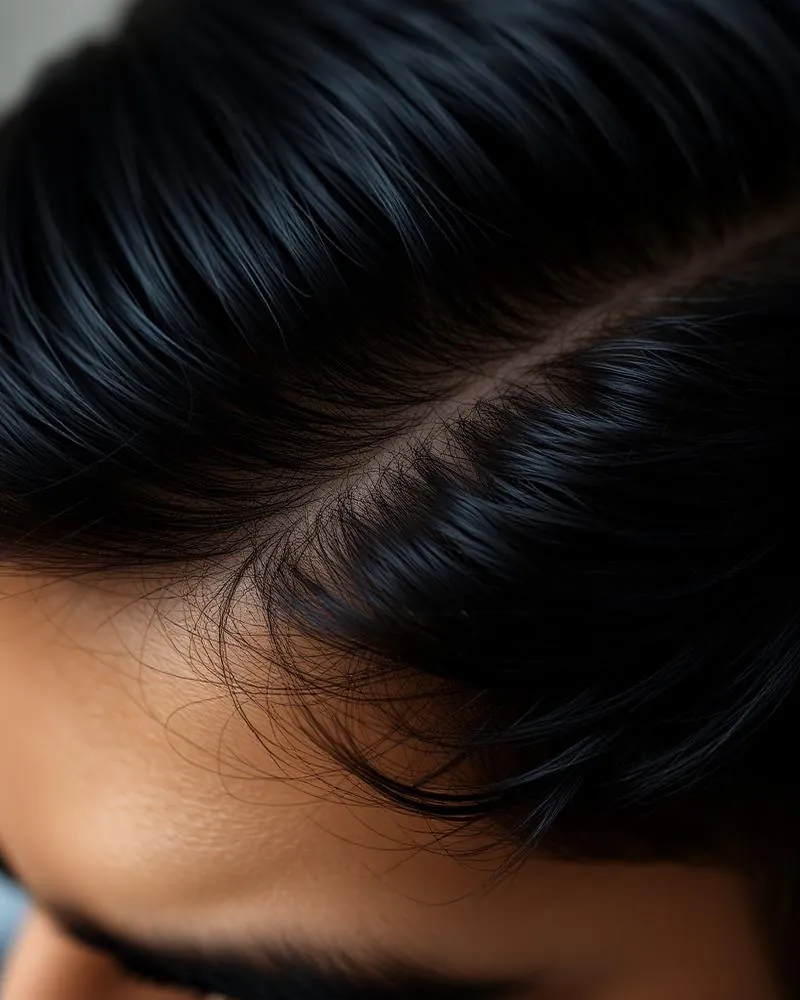
Indian hair follicles are predominantly coarse, dark, and often possess a slight subterranean curl beneath the epidermal surface. During extraction, a skilled surgeon must account for this root trajectory to avoid transection. During implantation, coarse dark hair against a lighter scalp demands extreme precision in angulation. Misaligned hair sticks straight out. DHI offers marginally tighter directional control along the frontal hairline, whereas sapphire-blade FUE achieves comparable results when executed by an experienced surgeon.
2. Graft Survival and Out-of-Body Duration
A follicle separated from its blood supply suffers ischemic stress. In classic FUE, grafts often sit in chilled holding solutions (such as HypoThermosol or Ringer's lactate) while hundreds of recipient slits are created. In DHI, extraction and implantation can occur concurrently in smaller batches, reducing out-of-body time. However, skilled surgical teams performing sapphire FUE mitigate this difference by working rapidly in synchronized teams.
3. Ability to Work Between Native Hairs (Diffuse Thinning)
Many Indian men experience diffuse unpatterned thinning across the mid-scalp and vertex rather than complete slick baldness. Traditional FUE slit-making can accidentally transect adjacent native hairs, inducing shock loss. DHI excels in diffuse thinning because the pen allows the surgeon to slip between existing hairs without damaging nearby roots, often without requiring the recipient area to be completely shaved.
4. Overall Session Capacity
Because loading an implanter pen is a meticulous, one-by-one process, DHI sessions are typically slower. A standard single-day DHI session safely accommodates 2,000 to 2,500 grafts. If your case requires 3,500 to 4,500 grafts to restore both a receded frontal hairline and an empty crown, traditional FUE is often the practical and logistically sound choice.
Head-to-Head Comparison: DHI vs FUE Hair Transplant India
| Parameter | FUE (Sapphire / Standard) | DHI (Direct Implantation) |
|---|---|---|
| Surgical Incision | Two-step: Slits made first, grafts inserted second | One-step: Slit and graft insertion happen simultaneously |
| Instrument Used | Sapphire or steel micro-blades + micro-forceps | Choi / Lion Implanter Pen (patented mechanical pen) |
| Graft Handling | Forceps grasp graft base/shaft | Follicle loaded into needle; zero forceps-to-root contact |
| Ideal Baldness Stage | Norwood Grades 3 to 7 (Large surface areas) | Norwood Grades 2 to 4, hairline refinement, beard restoration |
| Maximum Grafts / Session | 3,500 – 4,500+ grafts | 2,000 – 2,800 grafts |
| Shaving Requirement | Complete donor and recipient shaving usually required | Unshaven recipient area possible; donor still shaved |
| Recovery & Scabbing | Micro-crusts shed in 8–12 days | Minimal crusts, shed in 6–9 days |
| Average Cost in India | ₹25 to ₹45 per graft (approximate market average) | ₹40 to ₹80+ per graft (due to single-use pen consumables) |
Cost Breakdown: What Indian Men Should Expect
Cost is a decisive factor for patients looking for hair restoration in Bhopal and across Central India.
- FUE Pricing: Because standard FUE utilizes reusable sapphire blades and micro-forceps, overhead costs remain reasonable. A 3,000-graft procedure in Madhya Pradesh commonly ranges from ₹60,000 to ₹1,20,000, depending on clinic standards, physician involvement, and sterile theater protocols.
- DHI Pricing: Implanter pens require specialized disposable needles for each session, and the procedure demands greater surgical hands-on time per follicle. Consequently, DHI procedures frequently cost 30% to 60% more for an equivalent graft count.
While evaluating pricing, avoid "unlimited graft" promotions at non-medical franchise centres. Follicular overharvesting destroys your donor bank permanently, irrespective of the method selected.
Which Technique Is Right for You?
Choose DHI If:
- You have an early receding hairline (Norwood Grade 2 or 3) and need high density in the frontal zone.
- You suffer from diffuse thinning and want to preserve existing native hairs without inducing shock loss.
- You are in a public-facing profession and prefer an unshaven hair transplant (where only donor zones are trimmed).
- You are seeking facial hair restoration (beard, mustache, or eyebrow reconstruction).
Choose FUE If:
- You need extensive graft numbers (Norwood Grade 4, 5, or 6) to cover both the frontal zone and crown.
- You are operating within a practical budget and want maximum graft value per rupee.
- You do not mind shaving your entire head for a clean surgical field.
- Your donor area is rich and resilient.
At our clinic, our hair treatments are never limited to a one-size-fits-all formula. We frequently adopt a hybrid approach: using DHI for the ultra-refined anterior hairline boundary and sapphire FUE across the mid-scalp and vertex to maximize coverage efficiency.
The Real Secret: Surgeon Skill Trumps the Machine
Patients often ask us whether a machine or tool guarantees success. The medical reality is straightforward: an implanter pen in untrained hands will deliver poor results, while a master hair surgeon using standard FUE instruments can produce an undetectable, naturally flowing hairline.
Before booking a procedure at cosmetic clinics in Lalghati or scouring the web for "clinics near me in Bhopal," verify who actually handles your grafts:
- Does an experienced doctor design your hairline and perform the extractions?
- Are the technicians certified and operating under sterile operating-theater conditions?
- Does the clinic incorporate comprehensive post-procedure medical management (such as DHT blockers, peptide therapy, or GFC) to preserve your native hair?
Both Dr Pankaj Peswani and Dr Khushboo Peswani emphasize that surgical hair restoration must complement long-term medical therapy to prevent continuing genetic miniaturization behind the transplanted zone.
When to See a Doctor
If you notice persistent shedding exceeding 100 hairs a day, temporal recession forming an "M" shape, or widening of your central parting line, seek clinical evaluation early. Hair transplants transfer DHT-resistant follicles, but they do not stop native follicles from miniaturizing. An early trichoscopic scalp analysis can determine whether you require medical stabilization or surgical restoration.
Ready to find out which procedure suits your hair pattern? Book consultation with Dr Pankaj Peswani at HT Cosmetic & Trauma Centre in Bhopal for a personalized donor graft analysis.
Medical Disclaimer: This article is intended for educational purposes only and does not constitute formal medical advice. Individual candidacy for FUE or DHI surgery depends on scalp laxity, donor density, medical history, and clinical trichoscopic examination. Always consult a qualified plastic surgeon or certified hair transplant specialist before undergoing surgical procedures.
Frequently asked questions
Is DHI more painful than FUE?
No. Both DHI and FUE procedures are carried out under local tumescent anesthesia. Patients experience a brief pinching sensation during the initial numbing injections, but the extraction and implantation phases are virtually painless in both techniques.
Which method gives higher graft survival in Indian hair: DHI or FUE?
Both yield survival rates above 90–95% when performed by skilled surgeons. DHI offers a slight technical advantage by minimizing graft handling with forceps and reducing out-of-body holding time, but experienced sapphire FUE teams achieve comparable survival rates.
Can I get a DHI transplant without shaving my head?
Yes. One significant benefit of DHI is that it allows for an unshaven recipient procedure. While the donor zone at the back must still be trimmed, your existing frontal and mid-scalp hair can remain intact, making recovery less obvious.
What is the average cost difference between DHI and FUE in India?
In India, standard FUE generally ranges from ₹25 to ₹45 per graft, while DHI costs between ₹40 and ₹80+ per graft. The premium for DHI covers single-use implanter pens, specialized instruments, and extended surgical time.
How many grafts can be transplanted in a single DHI session?
A safe single-day DHI session generally caps around 2,000 to 2,800 grafts due to the precision and time required for pen loading. For larger baldness patterns requiring 3,500+ grafts, FUE or a multi-day hybrid approach is typically recommended.
Where can I get a personalized DHI vs FUE assessment in Bhopal?
You can consult Dr Pankaj Peswani at HT Cosmetic & Trauma Centre, located at Lalghati, Bhopal. We evaluate donor density, scalp elasticity, and hair caliber using trichoscopy to recommend the most effective, honest surgical approach.
Talk to our doctors in Bhopal
Book a private consultation at HT Cosmetic & Trauma Centre, Lalghati, Bhopal — or chat with us on WhatsApp.