
DHI vs FUE Hair Transplant India: Which is Right for You?
Deciding between DHI and FUE hair transplant in India? This guide helps Indian men understand the nuances of each technique, their benefits, and how to choose the right one for their unique hair loss needs and desired ou
DHI vs FUE Hair Transplant India: Which is Right for You?
Choosing between DHI (Direct Hair Implantation) and FUE (Follicular Unit Extraction) hair transplant methods is a critical decision for many Indian men experiencing hair loss, as both offer effective solutions but differ in technique, recovery, and suitability for specific conditions. While FUE involves creating recipient sites before implantation, DHI allows for simultaneous creation and implantation using a specialized implanter pen, potentially offering greater density control and reduced out-of-body time for grafts.
Ultimately, the 'right' choice between DHI vs FUE hair transplant in India depends on individual factors such as the extent of hair loss, hair characteristics, desired density, budget, and the surgeon's recommendation. At HT Cosmetic & Trauma Centre in Bhopal, we specialize in both advanced techniques, ensuring a personalized approach to your hair restoration journey.
TL;DR: DHI vs FUE Hair Transplant India
- FUE (Follicular Unit Extraction): Grafts extracted individually, recipient sites created, then grafts implanted. Known for versatility and suitability for larger areas.
- DHI (Direct Hair Implantation): Grafts extracted individually, then directly implanted into recipient sites using an implanter pen. Offers precise control over angle and depth, often preferred for higher density in smaller areas.
- Key Differences: Implantation method, instrument used, potential density, and recovery time.
- Suitability: FUE is generally good for extensive hair loss; DHI for defined areas, denser packing, and potentially quicker healing.
- Consultation is Key: A thorough assessment by a specialist like Dr Pankaj Peswani is essential to determine the best method for your specific needs.
Understanding Follicular Unit Extraction (FUE)
FUE is a widely popular hair transplant technique, particularly well-suited for addressing various patterns of male pattern baldness common in India. In this method, individual follicular units (groups of 1-4 hairs) are extracted directly from the donor area (typically the back or sides of the scalp) using a micro-punch tool. These grafts are then prepared and kept in a specialized solution while the surgeon creates tiny incisions (recipient sites) in the balding area. Finally, the extracted grafts are meticulously implanted into these recipient sites.
The FUE Process
- Donor Area Preparation: The donor area is shaved, and local anesthesia is administered.
- Graft Extraction: Individual follicular units are extracted one by one using a micro-punch.
- Graft Storage: The extracted grafts are carefully stored in a nutrient-rich solution to maintain their viability.
- Recipient Site Creation: The surgeon creates small incisions in the recipient area, determining the density, angle, and direction of hair growth.
- Implantation: The stored grafts are then manually placed into these pre-made recipient sites.
Advantages of FUE
- Minimal Scarring: FUE leaves tiny, punctate scars that are virtually undetectable, especially if hair is kept slightly longer.
- Versatility: Suitable for transplanting a large number of grafts and addressing extensive balding.
- Less Invasive: No linear incision, leading to a quicker and more comfortable recovery compared to older methods.
- Body Hair Transplant (BHT) Potential: In some cases, FUE can be used to extract grafts from other body areas if scalp donor supply is limited, which can be a consideration for some Indian men.
Disadvantages of FUE
- Time-Consuming: Extracting and implanting each graft individually can make the procedure longer than DHI for similar graft counts.
- Graft Handling: Grafts are outside the body for a period, requiring careful handling to ensure viability.
- Skilled Surgeon Required: The success of FUE heavily relies on the surgeon's expertise to minimize transection rates and achieve natural-looking results.
Exploring Direct Hair Implantation (DHI)
DHI is an advanced modification of the FUE technique, gaining significant traction in hair restoration clinics across India, including our facility in Bhopal. What sets DHI apart is the use of a specialized implanter pen (also known as a Choi Implanter pen). After the grafts are extracted using an FUE-like method, they are loaded directly into this pen. The surgeon then uses the pen to simultaneously create the recipient site and implant the graft, offering unparalleled control over the depth, angle, and direction of each hair follicle.
The DHI Process
- Donor Area Preparation: Similar to FUE, the donor area is prepared and anesthetized.
- Graft Extraction: Individual follicular units are extracted using a micro-punch, similar to the initial stage of FUE.
- Implanter Pen Loading: Each extracted graft is carefully loaded into the implanter pen.
- Direct Implantation: The surgeon uses the implanter pen to directly implant the graft into the recipient area. The pen creates the channel and inserts the graft in a single, fluid motion.
Advantages of DHI
- Enhanced Precision: The implanter pen allows for very precise control over the angle, depth, and direction of hair growth, leading to a more natural and aesthetic outcome, often crucial for front hairline reconstruction in Indian men.
- Higher Density Potential: Due to the precision, DHI can allow for denser packing of grafts, which is often desired.
- Reduced Graft Trauma: Minimal handling of grafts and reduced out-of-body time may improve graft survival rates.
- Faster Recovery (Recipient Area): Since no pre-made incisions are created, there might be less trauma to the scalp, potentially leading to faster healing and less visible scabbing in the recipient area.
- No Prior Shaving of Recipient Area: In some cases, DHI can be performed without fully shaving the recipient area, which can be an advantage for individuals who prefer discretion.
Disadvantages of DHI
- Limited to Smaller Areas: DHI can be more time-consuming for very large transplant areas due to the manual loading of each graft into the pen.
- Cost: DHI procedures can sometimes be slightly more expensive due to the specialized equipment and meticulous nature of the process.
- Highly Skilled Team Required: Requires a highly trained and experienced surgical team to perform effectively and efficiently.
DHI vs FUE Hair Transplant India: A Comparison
To help you better understand the differences and similarities between DHI vs FUE hair transplant methods, here's a comparative table:
| Feature | FUE (Follicular Unit Extraction) | DHI (Direct Hair Implantation) |
|---|---|---|
| Mechanism | Grafts extracted, then recipient sites created, then grafts implanted. | Grafts extracted, then directly implanted with an implanter pen (simultaneous site creation & implantation). |
| Instruments | Micro-punch for extraction, needles/blades for site creation, forceps for implantation. | Micro-punch for extraction, Choi Implanter Pen for direct implantation. |
| Recipient Sites | Created before implantation (pre-made incisions). | Created simultaneously with implantation by the implanter pen. |
| Graft Handling | Grafts are outside the body for a period, handled with forceps. | Minimal handling; grafts loaded into pen immediately after extraction, less out-of-body time. |
| Density | Good density achievable, but precision of angle can vary. | Often allows for higher, more precise density and natural angle. |
| Precision | Good, but depends on surgeon's skill in creating sites. | High precision in angle, depth, and direction of hair growth. |
| Scarring | Tiny, dot-like scars in donor area (virtually undetectable). | Similar tiny, dot-like scars in donor area. |
| Recovery | Generally quick; small scabs in recipient area. | Potentially faster healing in recipient area, less trauma. |
| Suitability | Extensive hair loss, larger areas, body hair transplant. | Smaller to moderate areas, hairline reconstruction, high density. |
| Cost (General) | Generally competitive. | Can be slightly higher due to specialized tools and technique. |
Factors to Consider for Indian Men
When deciding between DHI vs FUE hair transplant in India, specific considerations for Indian men often come into play:
- Hair Characteristics: Indian hair is typically thick and coarse. Both FUE and DHI can handle this, but the skill of the surgeon is paramount to avoid graft transection, especially with curly or wavy hair types.
- Desired Hairline: Many Indian men seek a dense, natural-looking hairline. DHI's precision in angle and direction can be particularly beneficial for crafting a very aesthetic and natural frontal hairline.
- Extent of Hair Loss: For very extensive baldness (Norwood 5-7), FUE might be more practical for transplanting a large number of grafts efficiently. For moderate loss or crown/vertex areas, DHI could offer superior density.
- Donor Area Availability: Both methods rely on a healthy donor area. A thorough assessment by Dr Pankaj Peswani will determine the viability and number of grafts available.
- Recovery and Lifestyle: While both have relatively short recovery times, DHI might offer a slightly quicker visual recovery in the recipient area due to less initial trauma.
- Budget: While both are investments, costs can vary. It's important to discuss this openly during your consultation.
Why Expert Consultation is Crucial
Choosing the right hair transplant method is not a one-size-fits-all decision. It requires a detailed assessment of your individual hair loss pattern, donor hair quality and quantity, overall health, and aesthetic goals. At HT Cosmetic & Trauma Centre, located conveniently in Lalghati, Bhopal, we emphasize personalized treatment plans. Dr Pankaj Peswani, our highly experienced hair transplant surgeon, will conduct a thorough examination and discuss all viable options with you.
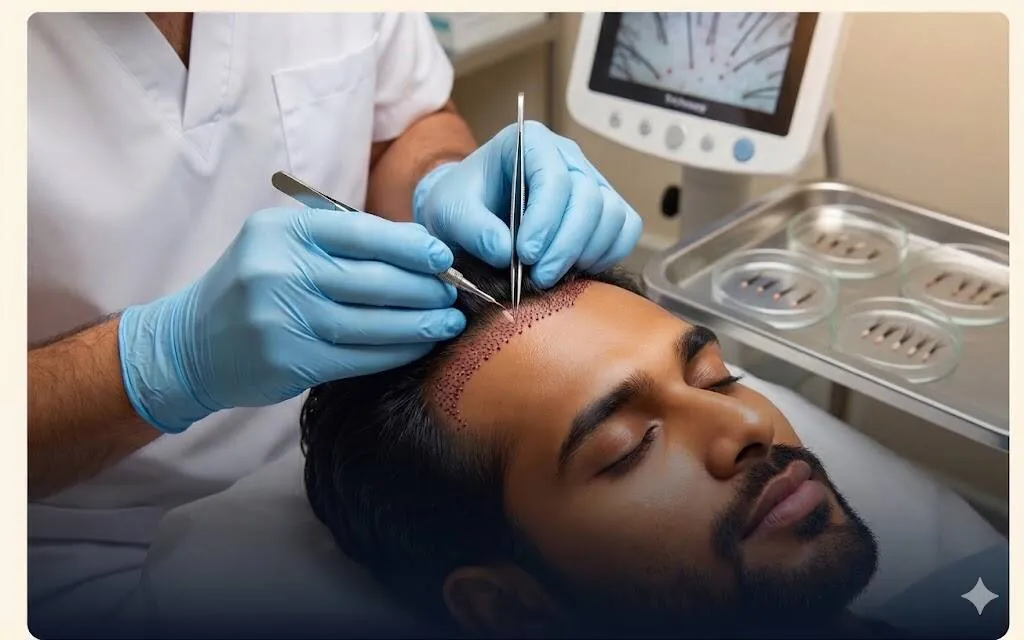
He will explain the nuances of DHI vs FUE hair transplant, illustrate expected outcomes, and help you make an informed decision that aligns with your expectations and provides the best possible results. Our clinics near me in Bhopal are equipped with the latest technology and a skilled team to ensure a safe and effective procedure.
When to See a Doctor
If you are experiencing noticeable hair thinning, a receding hairline, or significant bald spots, it's time to consider a professional consultation. Early intervention can often lead to better outcomes. Don't wait until hair loss is extensive. Schedule a consultation with an expert at HT Cosmetic & Trauma Centre in Bhopal to explore your hair restoration options, including a detailed discussion on DHI vs FUE hair transplant techniques.
Conclusion
Both FUE and DHI are highly effective hair transplant techniques, each with unique advantages. For Indian men seeking hair restoration, the choice between DHI vs FUE hair transplant in India ultimately hinges on individual factors and the expertise of the surgeon. DHI offers exceptional precision and density for those seeking meticulous hairline design, while FUE provides versatility for broader coverage. At HT Cosmetic & Trauma Centre in Bhopal, we are dedicated to providing state-of-the-art our hair treatments tailored to your specific needs. We invite you to book consultation with Dr Pankaj Peswani to determine the best path forward for your hair restoration journey.
Medical Disclaimer: The information provided in this article is for general knowledge and informational purposes only, and does not constitute medical advice. It is essential to consult with a qualified healthcare professional for any health concerns or before making any decisions related to your health or treatment. Individual results for hair transplant procedures may vary, and the suitability of a particular technique should be determined by a qualified surgeon after a thorough examination.
Frequently asked questions
What is the main difference between DHI and FUE hair transplant methods?
The primary difference lies in the implantation method. In FUE, recipient sites are created before grafts are implanted. In DHI, a specialized implanter pen simultaneously creates the site and implants the graft, offering greater control over depth and angle for a precise result.
Which method, DHI or FUE, is better for creating a natural-looking hairline?
While both can yield natural results, DHI is often preferred for hairline creation due to the implanter pen's ability to precisely control the angle, depth, and direction of each implanted hair follicle, leading to a very aesthetic and dense outcome, particularly for Indian hair types.
Is DHI hair transplant more expensive than FUE in Bhopal?
DHI can sometimes be slightly more expensive than FUE due to the specialized equipment (implanter pens) and the meticulous, labor-intensive nature of the process. However, costs vary based on the number of grafts and clinic, so a consultation is best for exact pricing at our Bhopal clinic.
Can DHI or FUE be done without shaving the entire head?
FUE typically requires shaving the donor area. DHI sometimes offers the option of not fully shaving the recipient area, which can be a preference for individuals seeking more discretion during the recovery phase, especially for smaller transplant areas.
How long is the recovery time for DHI vs FUE hair transplant?
Both DHI and FUE have relatively quick recovery times compared to older methods. DHI might offer a slightly faster healing and less visible scabbing in the recipient area due to less trauma, but overall, both allow patients to resume normal activities within a few days to a week.
Talk to our doctors in Bhopal
Book a private consultation at HT Cosmetic & Trauma Centre, Lalghati, Bhopal — or chat with us on WhatsApp.